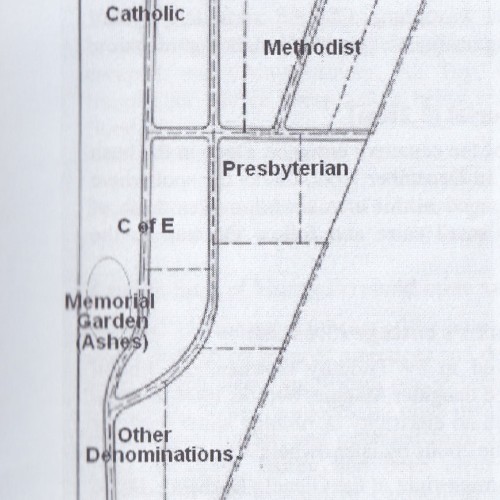
Although it is thought that burials took place here from the time of the early gold diggings in the mid-1850s, this cemetery was not officially surveyed until 1860, and burials recorded from that date. As with most cemeteries of its era, it was divided into denominational sections – Roman Catholic, Presbyterian, Methodist and Church of England - with the Chinese in their own section at the northern end.
As the plots were not numbered until 1872, and not all graves have headstones, many of the dead lie in unmarked graves. Amongst them, are two Aboriginal Australians – an indigenous woman known as Jennie who died in 1873 at Dreamer’s Hill south of Linton, and a man known as King Billy, regarded as ‘the King of the Booriyalloak Tribe’, who died on 8 January 1882 at Mt Bute station.
In 2007, the Linton and District Historical Society erected a commemorative board in the Chinese section to the Chinese settlers of the district and attempted to identify those buried here. Amongst the seventy-four burials there is one European wife of a Chinese man, and two Chinese-Australian babies. There were once numerous headstones but now only eight remain. There are also Chinese men recorded as buried in other parts of the cemetery, for example, Wong Pow, who died in 1896 of phthisis and is buried in the Church of England section.
Over the twentieth century, the cemetery has added a lawn section, a rockery for cremated remains, and a memorial to stillborn babies. The cemetery is administered by the Linton Cemetery Trust.
In the bush north of here along the Snake Valley Road, in areas known as the Hard Hills and Chinaman’s (or Wet) Flat, there was a large Chinese community. There were many Chinese mines, dams, horse puddling machines, stores and market gardens.